Don’t look now but 2026 is already half over.

This morning I realized that I have spent many hours talking about the struggles we face in the cattle business, (grazing acres, inventory, infrastructure collapse), but I have not spent much time digging into the current status of the pork business. Ironically, I have owned a pig every day of my life since I was 4 years old. Today, we raise purebred Spotted pigs and have not sold a market hog to the commercial market since 2017. We sell everything directly to consumers through custom-exempt butcher shops and it works great.
With that said, as I look at the status of the commercial pork industry, some interesting developments have occurred. There was a time, not long ago, that the United States sold 1 of 5 pigs produced in the states to China. China is still the largest pork-consuming nation in the world. but not on a per capita basis. About 66% of the meat consumed in China is pork, to the tune of 88 pounds per person annually. To put that into perspective, Americans consume about 50 pounds per capita each year. The European Union and South Korea are the leaders globally in per capita consumption of pork at more than 92 pounds per person.
The U.S. is currently the largest pork exporter in the world and only import about 3% of the pork we consume. The U.S. Department of Agriculture forecasts U.S. pork exports to grow by 8.6% from an expected 7.2 billion pounds in 2026 to 7.8 billion pounds by 2035, surpassing the previous record of 7.3 billion pounds set in 2020 by the year 2029.
Mexico remains the top export destination for U.S. pork, accounting for approximately 38 to 41% of total U.S. pork export volume in 2026, supported by the USMCA trade agreement. Japan has surpassed China to become the second-largest export destination, with January 2026 exports reaching a record 27,910 metric tons.
Southeast Asian markets are emerging as critical alternative growth areas following new reciprocal trade deals. Malaysia saw record imports exceeding $24.5 million in 2024, with new agreements opening access for all eligible U.S. facilities. Cambodia, Thailand and Vietnam also secured frameworks to eliminate tariffs and non-tariff barriers, though implementation varies.
U.S. pork imports in 2026 are projected to increase by 3% compared to the previous year, with an estimated import volume of approximately 522 thousand metric tons. Mexico remains the top global importer of pork overall, while China has largely withdrawn as a major importer of U.S. pork due to increased domestic self-sufficiency following the 2019 African swine fever outbreak.
One has to ask the question, why the constant attack on beef production? We hear about methane emissions from cattle and nothing from pigs or chickens. Interestingly, I just found some information put forth by Our World in Data. I am confident this is an offshoot of the United Nations and most likely are not friendly to agriculture, but look at this:
Producing a pound of meat requires vastly different amounts of land depending on the animal. Beef has the highest land footprint, requiring about 1,600 square feet per pound. Pork needs about 78 square feet, and chicken is the most land-efficient, taking about 55 square feet per pound.
While I can make the case all day and night that grazing animals are vital for planet health, it is clear to me there are global powers that want to shed a negative light on animal protein and the vast amount of land required to produce it. I am going to do a deeper dive into the rhetoric surrounding this scenario. In the meantime, I smell bacon so that’s all for now.
The views expressed here are the author’s own and do not represent the view of High Plains Journal. Trent Loos is a sixth generation United States farmer, host of the daily radio show, Loos Tales, and founder of Faces of Agriculture, a non-profit organization putting the human element back into the production of agriculture. Get more information at www.LoosTales.com or email Trent at [email protected].
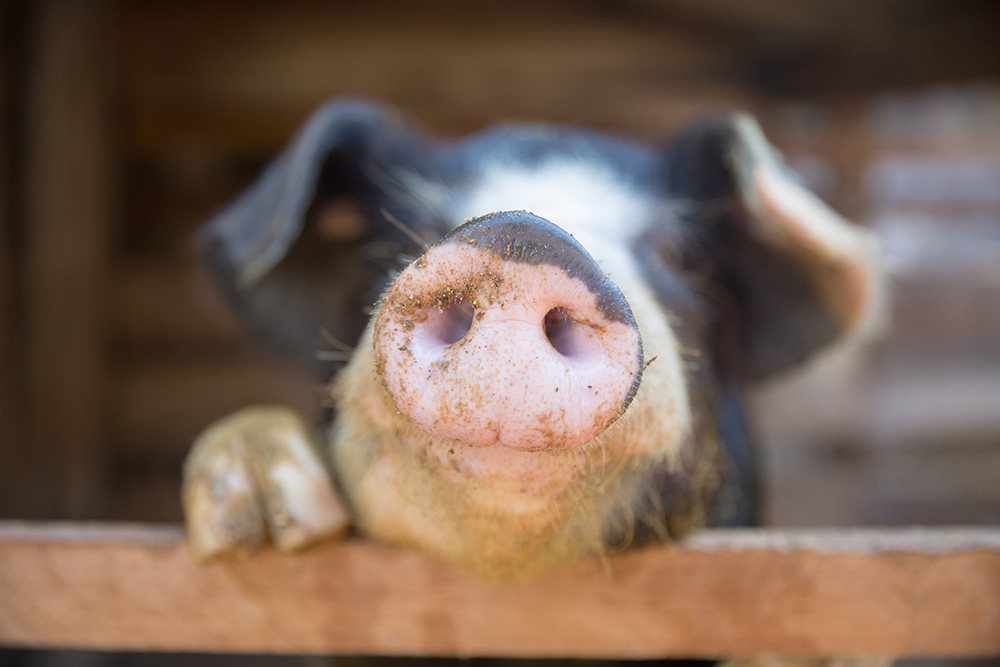
PHOTO: Pig nose in the pen. (Adobe Stock-#223646422 │ Nexa)