
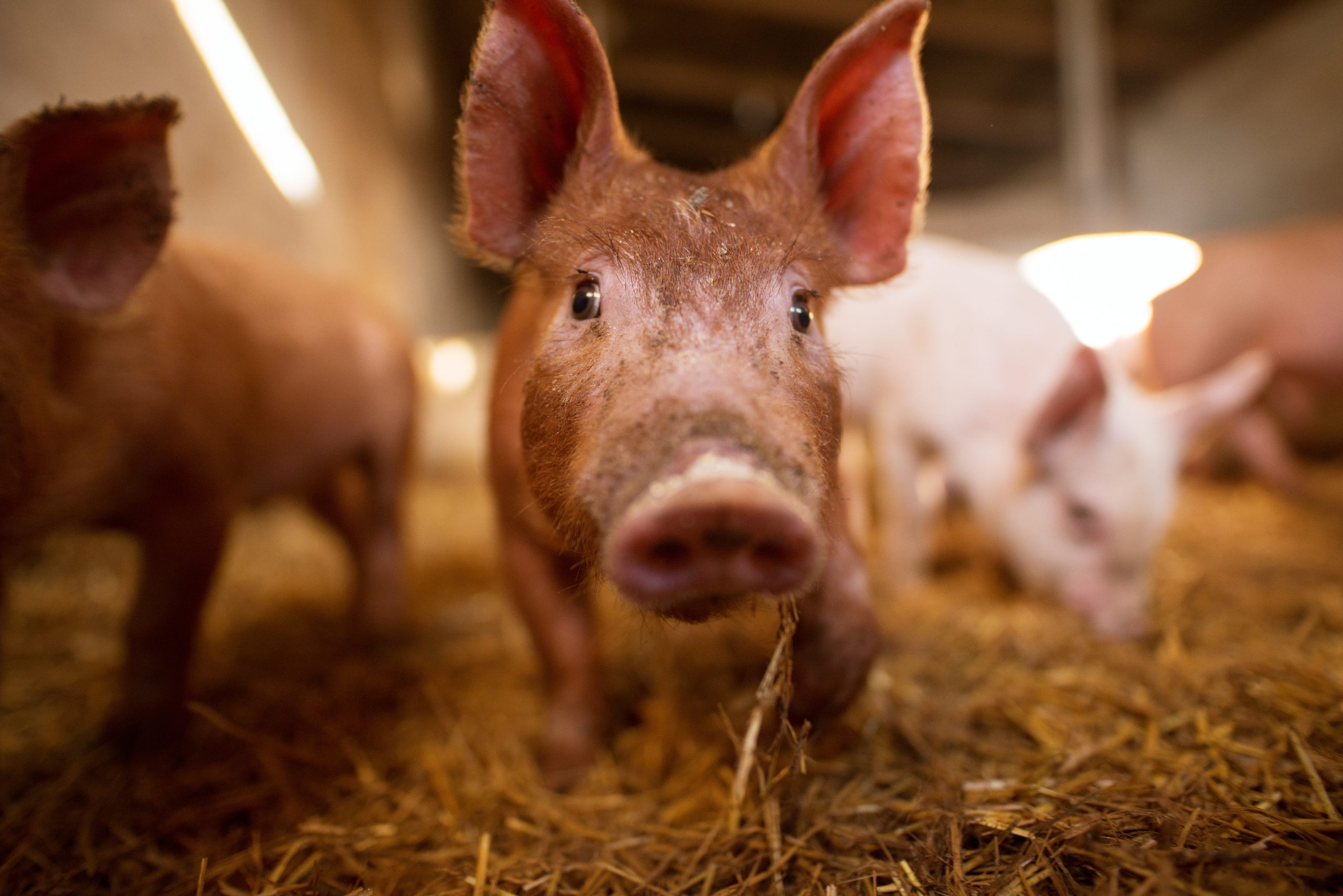
The third quarter hog and inventory report came out in late September and for the third quarter it showed a slight dip—and a couple of surprises.
As of Sept.1, there were 74.5 million hogs and pigs on United States farms, down 1% from September 2024 but up 1% from June 1, according to the Quarterly Hogs and Pigs report published by the U.S. Department of Agriculture’s National Agricultural Statistics Service.
The inventory of all hogs and pigs, the breeding herd, and total market hog inventory were all reported to be down more than 1% from last year, and several inventory categories in the September Hogs & Pigs Report came in below the average of analysts’ pre-report expectations, said Holly Cook, economist with the National Pork Producers Council. “Generally, more than a 1% difference between the pre-report expectation and actual reported inventory is considered a surprise, and by that measurement, there were several categories that were a surprise,” Cook said.

The breeding herd was reported to be 5.934 million, down 1.8% compared with Sept. 1, 2024, and the lowest breeding inventory for this quarter since 2014, she said.
All USDA estimates, except for the 180 pounds and over market hog inventory, were below the average of pre-report expectations, said Lee Schulz, chief economist at Ever.Ag.Also, eight USDA estimates were below the lower bound range of pre-report expectations.
“Anything plus or minus more than one percentage point from the average of pre-report expectations is commonly considered a surprise,” Schulz said. “For each report there can be a couple of USDA estimates that are a surprise under this criterion. In this report, there were four USDA estimates that were three percentage points or more below the average of pre-report expectations. If a one percentage point difference is a surprise, then a three-percentage point difference is a shocker.”
When comparing to year ago levels, while currently stable, but possibly tightening numbers, he said.
The inventory of hogs weighing 180 pounds and over on Sept. 1, was up 0.3% compared to Sept. 1, 2024. Hogs weighing 180 pounds and over on Sept. 1 come to market in September through mid-October. On average, pre-report analysts expected the heaviest weight group inventory down 0.6% compared to 2024, Schulz said.
September slaughter to-date is down 0.2% compared to a year ago, he said.
The inventory of hogs weighing 120 to 179 pounds on Sept. 1, was up 0.4% compared to Sept. 1, 2024, he added.
“These hogs would be expected to be slaughtered mid-October through mid-November,” Schulz said. “On average, analysts expected this inventory to be up 0.5% compared to 2024.
Pig crop
The June through August 2025 pig crop at 34.078 million head was down 2.6% compared to the same period a year prior and is 2.292 million head lower than the record pig crop for the quarter recorded in 2019, Schulz said. These pigs will come to market January through March 2026.
Of the 74.5 million hogs and pigs, 68.5 million were market hogs, while 5.93 million were kept for breeding.
The U.S. breeding inventory, at 5.934 million head, was down 1.8% from last year, and down 0.3% from the previous quarter, Schulz said. This is the smallest Sept. 1 breeding herd since 2014.
“Coming into the report, there was some thought that producers may have expanded the breeding herd in the last three months,” Schulz said. “Yes, sow slaughter over the last 15 weeks has been down 5.9% or 51,754 head compared to the same period in 2024. “However, at a somewhat static replacement rate one would expect lower sow slaughter because there are fewer sows to cull from.”
He also noted that sow and boar imports for slaughter from Canada are down 4.2% or 3,772 head over the last 15 weeks. Furthermore, USDA revised the June 1 breeding herd down by 0.5% or 30,000 head.
“As you think about the breeding herd, one could argue we have the most productive breeding herd ever,” Schulz said. “This is evidenced by continued increases in litter rates.” The average pigs saved per litter in the U.S. was 11.82 for the June through August 2025 period, compared to 11.72 last year, he said, adding the June through August litter rate has now broken a record in 2023, 2024 and 2025.
Between June and August, 34.1 million pigs were weaned on U.S. farms, down 3% from the same time period one year earlier, NASS reported.
The lightest two market hog inventories came in markedly lower than analysts’ pre-report expectations and lower than a year ago, Schulz said. Hogs weighing 50 to 119 pounds were down 2.3% compared to a year ago. These hogs are expected to come to market mid-November through December 2025. On average, analysts had this category up 0.8%. Pigs under 50 pounds will come to market January through February 2026 and were down 2.4% compared to last year. This was much lower than analysts’ expectations of an increase of 0.7%.
From June through September 2025, U.S. hog and pig producers weaned an average of 11.82 pigs per litter, NASS reported.
The report indicates that the June to August pig crop was down over 3% from 2024, and the two lightest market hog inventories were down more than 2% compared to one year ago, implying likely lower availability of market hogs in late 2025 and early 2026, Cook said.
Farrow
U.S. hog producers intend to have 2.86 million sows farrow between September and November, and 2.82 million sows farrow between December 2025 and February 2026.
U.S. hog producers intend to have 2.855 million sows farrow during the September through November 2025 quarter, which would be down 2.4% from the actual sows farrowing during the same period one year earlier and the smallest for the quarter since 2013, Schulz said.
“This is the second sows farrowing intention estimate for the September through November 2025 quarter and producers dropped 91,000 sows from the intentions estimate from three months ago in the previous Quarterly Hogs and Pigs report,” he said.
September through November 2025 sows farrowing will drive two quarters ahead slaughter or April through June 2026 slaughter, he added.
Other observations
Pork producers do have some positives to build on, Cook said, adding stronger hog prices and lower input costs have supported an average return of $16 per head over the past 12 months, according to reports from Iowa State University. After severe losses in 2023 and 2024, the profit opportunities available in 2025 have supported continued financial recovery for pork producers across the country, she said.
Schulz said producers should consider all tools and strategies available to accomplish price risk management objectives.
“Do not wait for the market to come to you,” Schulz said. “Remember, the point of maximum financial risk is at the market peak, when prices (or profits) are highest.”
Strategies should include establishing price floors and insure prices or margins.
“Set several target prices to allow for changing market trends,” Schulz said. “Producers have been on defense for much of the last couple of years due to adverse conditions in late-2022 through early-2024.”
Now is an opportunity to go on offense to take advantage of current and future market opportunities, he added.
In recent years discussion has been on managing in tough times, he said in reality, the most important decisions are often made when times aren’t so tough. If one of the goals of the business is to produce profits for personal use, then profit taking is in line with operational goals.
If the overriding goal is to grow the business, then consider strategies to acquire productive assets, Schulz said.
“If the ultimate vision is long-term profitability, then plan ahead for future times when generating profits might be more challenging,” he said.
Export picture and other variables
Exports of pork and variety meats are down 4% year-to-date by volume through July, Cook said. When comparing to the same month in 2024, exports in April and May were down 15% and 11% respectively, while total exports increased 7% in June, and were down 1% in July, she added.
While industry watchers are keeping an eye on high beef prices and a small cowherd, Schulz advises pork producers to focus on what they can control.
Iowa hog producers accounted for the largest inventory among the states, at 25.1 million head, NASS reported. Minnesota had the second largest inventory at 8.75 million head. North Carolina was third with 7.8 million head.
Dave Bergmeier can be reached at 620-227-1822 or [email protected].
Related coverage and resources
- Related on HPJ: U.S. hog inventory shows slight uptick
- Related on HPJ: US hog inventory shows slight dip in numbers
- Outside resource: National Pork Board

