A recent announcement by Secretary of Defense Pete Hegseth is kicking the United States domestic drone market into high gear in ways that will eventually benefit all drone customers—including farmers and agricultural drone users.
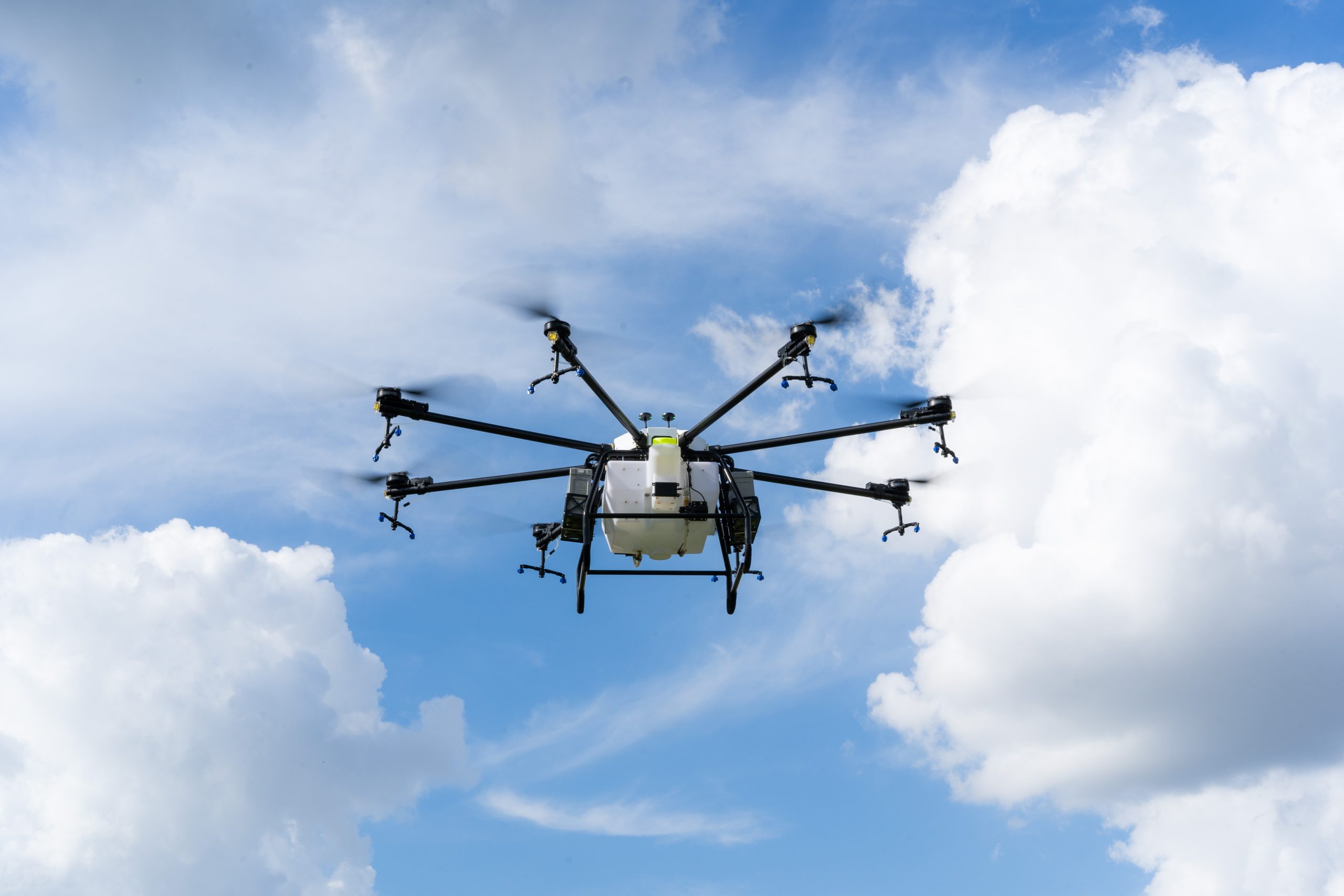
It’s an exciting and unnerving time to be part of the drone industry. Drones are much cheaper to produce than conventional missiles and other weapon delivery systems, and have overturned old military doctrines, budgets and balances of power. Innovations in how states like Ukraine and Israel—as well as non-state actors like the Houthis and Hamas—are adapting and using drones on the battlefield have blurred the distinction between military and non-military drones and focused the attention of all the world’s militaries. (Above is a drone in action in a photo courtesy of Hylio.)
On July 10, Hegseth announced a plan in support of President Donald Trump’s recent Executive Order 14307 “Unleashing American Drone Dominance,” with a goal of eliminating barriers to purchase and train with emerging domestic UAS technology. In support of Hegseth’s requirement to expand the Blue UAS Cleared List within 90 days, the Defense Innovation Unit—an agency whose sole task is to speed up adoption of dual-use technology by the military—announced updates to provide pathways onto the Blue List “to accelerate trusted drone capabilities to the warfighter.”

Companies on the Blue List have been security-audited and pre-cleared, and enjoy a speeded-up purchase and acquisition process. Most are American, but the list includes French, Swiss and Swedish companies.
When the Defense Department created its Blue List, the Association for Uncrewed Vehicle Systems International (AUVSI), a drone industry trade group, responded by creating its own Green List of companies that met blue-list requirements, in anticipation of being added to the blue List. Hegseth’s order fast-tracks the integration.
“Building on its existing data sharing agreement with the Association for Uncrewed Vehicle Systems International, DIU is recognizing Green UAS certification as an authorized pathway to achieving Blue UAS Cleared status. Effective immediately, drone platforms that have successfully completed the Green UAS certification process will be added to the Blue UAS Cleared List,” the order reads.
One important reason for the lists in the first place was to exclude drones or components made in adversary countries, especially China, from entering defense supply chains. Chinese-made non-military drones, especially those made by DJI, have dominated global and U.S. markets. While the latest National Defense Authorization Act stopped short of banning Chinese-made drones outright, the action is still possible with the Federal Communications Commission.
The Covered List maintained by the FCC under the Secure and Trusted Communications Networks Act of 2019 identifies companies and equipment that are deemed to pose an “unacceptable risk to U.S. national security,” particularly in telecommunications and video surveillance. Government entities are already prohibited from buying DJI drones.
The Blue UAS website was updated to reflect the immediate expansion of the Blue UAS Cleared List to include Green UAS Certified platforms. The site also now delineates a distinction between “Blue UAS Cleared” and “Blue Select” platforms that have been either competitively selected or sponsored by a service or CCMD (unified combat command) and have received an authority to operate (ATO).
The DIU is working closely with the deputy secretary of defense’s office to finalize a Blue UAS Checklist that will facilitate the Blue UAS certification pathways laid out in Hegseth’s memo. Empowered agencies, general officers, flag officers, and members of the senior executive service will be able to certify UAS platforms, components and software using the checklist. DIU was to make the checklist available on or before Aug. 1. When the integration is complete, the drone acquisition process will be transferred to the Defense Contract Management Agency, which oversees defense department contracts.
Benefits to ag drone users
So how is all this going to benefit domestic non-military drone users? In several ways, according to Arthur Erickson, CEO and co-founder of Hylio AgDrones. The effects of the change will be felt “in a matter of months,” he told High Plains Journal.
Florida, Mississippi, Arkansas, Connecticut, and Tennessee—four heavy agriculture states—have already passed laws banning all state entities from buying or using Chinese-made drones; some mention DJI by name. Connecticut even banned the purchase and use of Chinese drones by the private sector. These laws had the effect of restricting access to agricultural drones at a time when most U.S. drone production was directed toward the military.
As drone-makers expand to meet the defense market, and find it easier to sell their products, economies of scale should lower prices down the road for all drones—including commercial ones. Erickson expects new entrants to the booming domestic drone market. Expanded production should also intensify competition and result in more features being offered on commercial drones, he said.
Although competition will intensify in some ways, the expanding demand pie will also encourage competitors to work together in partnerships and could also encourage specialization.
“Maybe a company will realize that its core expertise is in drone leasing, so it will concentrate on providing services,” Erickson said.
Hylio itself specializes in agricultural applications, but it has also provided components to other drone makers. Hylio drones have treated more than 1 million acres. Its Agro Drone was lauded as “revolutionizing the agriculture industry” back in 2018, and Hylio honed its expertise on Central American farms. Although it’s not the largest American drone-maker, it’s currently the only one offering heavy-duty spray drones with swarming capabilities.
Like other domestic drone-makers, Hylio plans to take advantage of the expanded defense market as well—without neglecting its core market, Erickson said. Hylio currently has about 70 employees but expects to expand to 200 or 300 “within a few years.”
It was partly in anticipation of this expanded demand that Hylio built its expanded facility in Richmond, Texas—a space he has said could produce 3,000 drones a year next year, 4,000 annually by 2027 and continue until a rate of 5,000+ a year is reached at full capacity.
David Murray can be reached at [email protected].
Related coverage and resources
- Related on HPJ: Domestic drone maker ramping up to meet long-term demand
- Related on HPJ: American drone maker prospers amid pressures on producers
- Outside resource: USDA National Institute of Food and Agriculture