Officials work to get word out about NWS
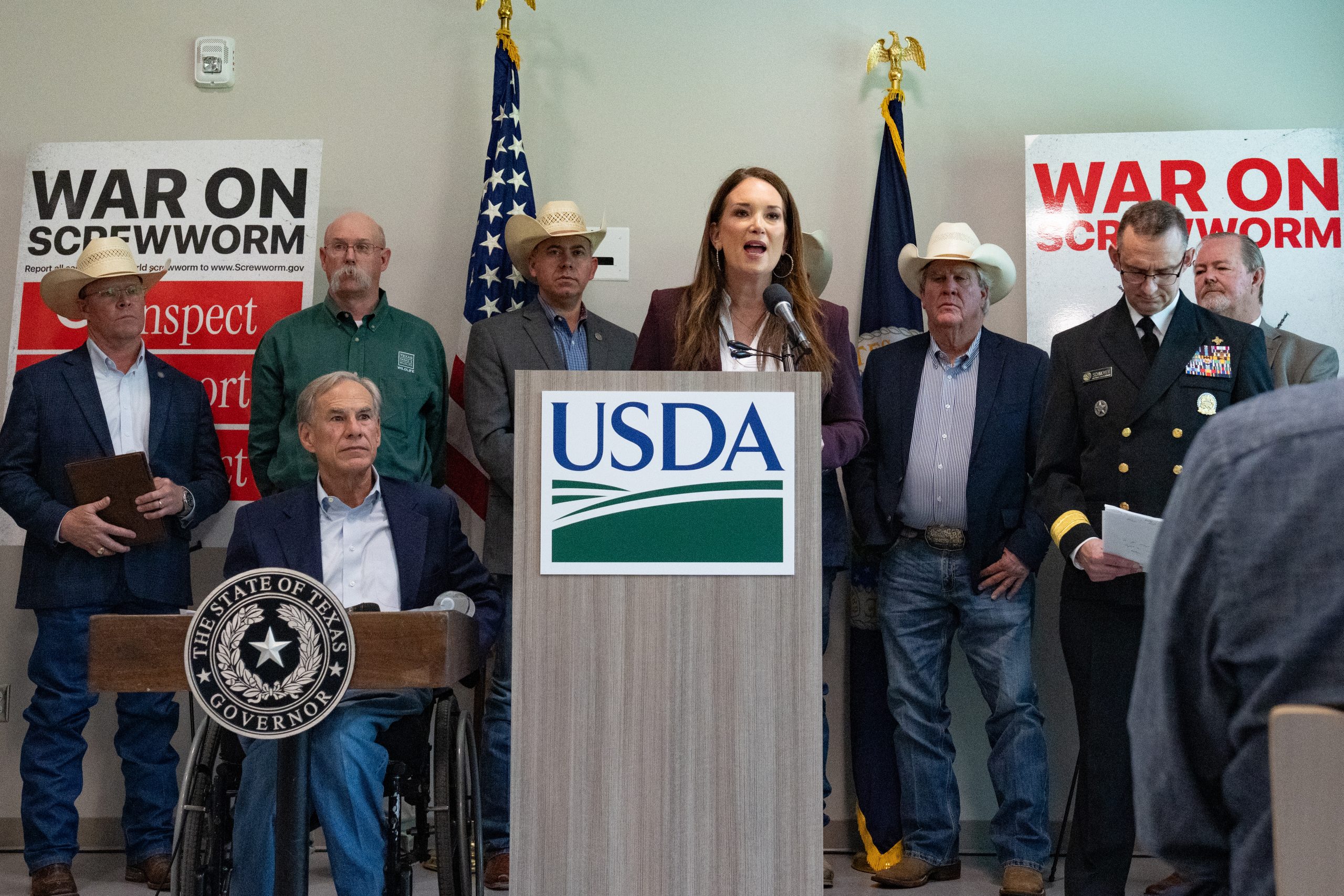
U.S. Secretary of Agriculture Brooke Rollins provided an update on the New World screwworm as she spoke at a recent press conference in Texas.
As of June 18, there are 12 cases of NWS, with the last case being reported June 12, according to screwworm.gov. The first case in the United States was reported June 3 in a very young calf in Zavala County, Texas.
Rollins was joined at the June 8 updater by Texas Gov. Greg Abbott; Admiral Michael Schmoyer, APHIS Associate Administrator; Texas Animal Health Executive Director Bud Dinges, Alan Cain with the Texas Parks and Wildlife; USDA Under Secretary Scott Hutchins; and president of the Texas and Southwestern Cattle Raisers Association, Steven Diebel.
Rollins said the expansion of sterile fly production and dispersal capacity is a top priority. Last year a dispersal facility was launched in south Texas, and millions of dollars was invested in retrofitting a facility in Metapa, Mexico.
“Those sterile flies will begin to come online this month, so very good timing, of course,” Rollins said. “The massive facility we’re building in Moore—the production facility, we broke ground just a couple of months ago, expecting to reach in the hundreds of millions of additional sterile flies by mid next year.”
Expansion of sterile fly dispersal along the U.S.-Mexico border is expanding as well too, according to Rollins.
“We’re conducting the first ever ground release of the New World screwworm fly via a ground release vehicle,” she said. “Again, all of these efforts to ensure that we did everything we could to contain the screwworm south of the border to give us more time to prepare.”
Rollins also announced the advancement of the next generation of tools and technologies. USDA launched the New World Screw Worm Grand Challenge in 2025. The $100 million investment in “innovative solutions” from the private sector to help eradication efforts and expand sterile fly production.
“We have spent the last couple of months reviewing over 226 applications through the Grand Challenge, and later this week we will begin rolling out more rapidly than we had planned to,” she said. “We’re already moving fast, but now you will hear of some of those innovations coming out week by week by week.”
The Knipling-Bushland U.S. Livestock Insects Research Laboratory opening in Kerrville, Texas, will provide the world’s most cutting-edge research capabilities.
“We have been over the last year strengthening surveillance detection and preparedness. We are actively monitoring over 8,000 surveillance traps that we set out last year along the U.S.-Mexico border and have examined in that time 59,000 plus fly samples and over 19,000 wildlife specimens since January of last year,” she said. “On top of this, enhancing the border surveillance through increased trapping, increasing our mounted patrols, our tick riders.”
Rollins gave a shout out to the south Texas ranchers.
“They now become the front lines for this battle,” she said. “We now know what the enemy looks like. We now understand what we have to do, and for those men and women, our ranchers along the border, and frankly, throughout Texas, who are have eyes on their cattle in the morning, in the afternoon, in the evening, who are the front lines to ensure that we can do everything we can to protect our livestock industry.”
Governor
Gov. Abbott thanked Rollins for being in Texas and what the USDA has been doing to help Texas producers.
Abbott doubled down on what Rollins mentioned—“there is a well-established prevention and solution for the spread of the screwworm that the federal government has implemented in the past, and that is sterile flies.
“Prevention requires the release of millions of sterile flies in targeted regions,” Abbott said. “The USDA is now importing and dispersing those flies in south Texas and will recalibrate to deploy those sterile flies as needed and where needed.”
Abbott said last year he directed state agencies to establish a response team. This team brought together livestock producers, veterinarians, wildlife experts, and federal partners to prepare in advance. He also issued a statewide disaster declaration for all 254 counties in the state to mobilize resources and to strengthen prevention and response efforts in advance.
“Friday (June 5) I updated the statewide disaster declaration to make two things clear,” he said. “I authorized the use of all available resources of state government to respond to this disaster and to reassign all resources needed to address the spread of the screwworm, I am making available any and all state personnel, including personnel from our university systems, to accelerate the movement of sterile flies into Texas and to accelerate the construction of the new sterile screw worm production facility in Edinburgh.”
One example of this is Texas A&M University will immediately deploy fly testing facilities to all of the affected areas, “spearheading a larger role for Texas A&M,” he said.
Abbott activated the state emergency operations center June 8 and it is staffed 24/7, every day.
Texas has also announced a certified inspector program. By June 13-14, Abbott expected in coordination with TAMU and TAHC to have the training module online.
“Ranchers and cattlemen can be certified to inspect their animals to ensure no interruptions to the continuity of business,” he said. “Additionally, the AgriLife extension has moved mobile equipment to Uvalde for closer on-site testing that can be moved elsewhere as needed.”
Abbott said Texas ranchers can do a couple things right now to protect their livestock from NWS. Check animals daily—for wounds, even small wounds like tick bites and navel openings.
“Treat wounds promptly and work to reduce fly populations around your operations,” he said. “Report immediately any suspicion of New World screwworm in wounds to the Texas Animal Health Commission. Anyone can report. You don’t have to be a veterinarian to report. If you come upon an animal that you suspect of having the screw worm, do not move it.”
Suspected cases can be reported to the TAHC 24-hour veterinarian line at 1-800-550-8242. If observing deer, feral hogs, exotic game animals, or other wildlife showing signs of infestation or unusual wounds, report immediately to the Texas Parks and Wildlife Department or your local Texan Parks and Wildlife biologists. The Texas Parks and Wildlife Biologists can be reached at 512-389-4505.
“Pets like dogs and cats with outdoor exposure and untreated wounds need close monitoring as well,” Abbott said. “This is a highly treatable condition if acted upon quickly.”
TAHC update
Dinges praised his partners for the work being done to fight NWS.
“We are in close coordination with our partners taking regulatory action we have been preparing for since 2024,” he said. “The goal of our response efforts is to prevent the spread of screw worm out of an infested zone but keeping the continuity of business going.”
People in the infested zones and across Texas need to continue to report suspicions as they see them.
“Quick notification leads to quick detection and quick response to stop this pest from spreading,” Dinges said. “Animals will still be able to move. We just need to make sure that they are not moving, they’re moving safely, and are not moving the screw worm with them.”
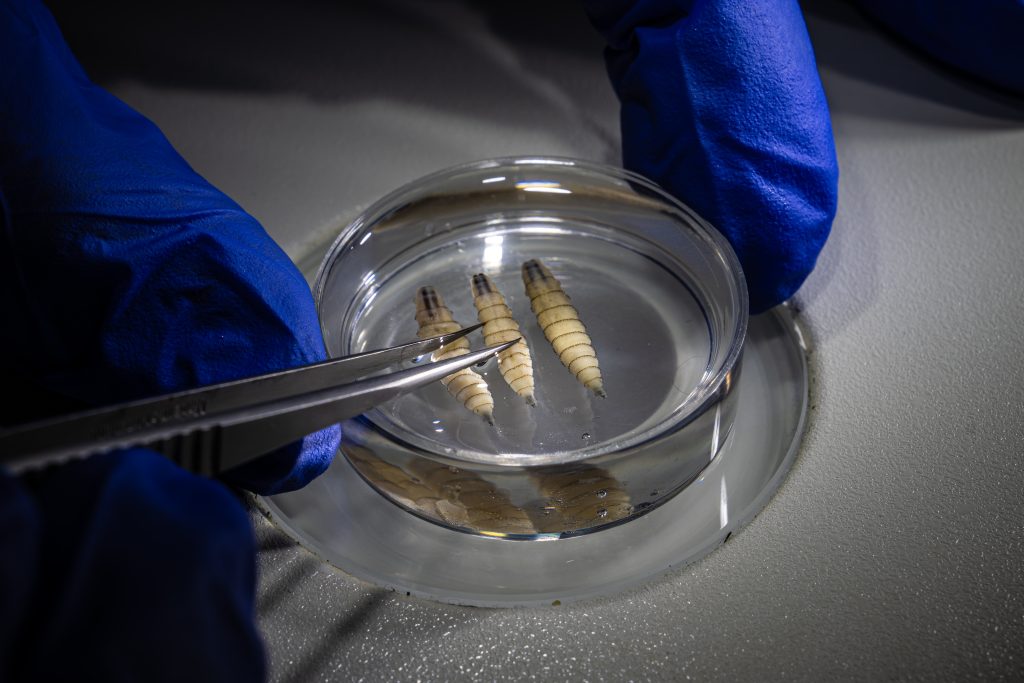
It is important for animal owners to remember, infestations from NWS can be prevented.
“Animal owners need to look at their animals as often as possible, and stay vigilant, monitoring for wounds that can be covered and treated,” he said. “This is not an infectious disease. This is not a food safety issue. These flies may lay their eggs in, on, or near a wound for an animal to become infested.”
Dinges said animal surveillance is a very large part of how greater impacts of this pest can be prevented. NWS is a highly treatable condition that, if caught early, can be treated and spread prevented.
“We have tools in our toolbox to prevent devastating impacts that we didn’t have before,” he said. “We want to remind folks that veterinary- client relationship is critical to best address specific animal and operational needs for treating new world screwworm infestations.”
The response will continue, but it’s going to take partnerships between government, industry, and animal owners to continue “to work together to stop new world screw worm in its tracks,” Dinges said.
Wildlife
Cain said Texans love their wildlife, and the state is incredibly diverse when it comes to it. For example, Texas has about 5.4 million white-tailed deer throughout the state—an incredible economic driver for many rural communities, garnering nearly $9.6 billion each year just on deer hunting.
TPW will help coordination with USDA, TAHC and others to help monitor wildlife through surveillance enforcement of live animal inspections of native wildlife movements, such as deer breeding, wildlife rehab, scientific research permits, and outreach to the public.
“The Texas Parks Wild Department has an extensive network of private landowners that our biologists and game wardens work with day in and day out,” Cain said. “That network encompasses approximately 12,000 landowners and ranch manager contacts of approximately 32 million acres across the state through our wildlife management activities on those properties.”
Having a resource like that with landowners is critical to help leverage contacts to be able to support TAHC and USDA response and engagement, especially when it comes to fly trapping, establishment of release areas and inspection requests and general surveillance in those areas.
“Landowner cooperation is going to be critical,” Cain said. “Wildlife are not like cattle, you can’t gather them up, you can’t look at them. We need you when you’re out there in your pastures and driving around, checking your cameras, checking wildlife, especially during the hunting season.”
Cain is hoping the 1 million licensed hunters in Texas can also help.
“(That) provides us an incredible outreach opportunity to get information out, factual information on how to respond, and we continue to work hand in hand with Texas Animal Health Commission and USDA,” he said. “And hopefully we can take care of that soon.”
Cattle raisers
Diebel at TSCRA also appreciated being part of the event and partnerships created by the NWS outbreak.
He stressed a couple of things during his segment.
“No. 1, no need to panic. We have had a plan in place, and we’ve had that plan, and we know it works,” he said. “Meat is safe. We do not have a food safety issue. Treated and inspected cattle can move. We’ve talked about these protocols with Animal Health Commission, Parks and Wildlife Department, and all of our partners for many months now.”
NWS is highly treatable, and if detected early, can be very solvable.
“Monitor and report. We really want to reiterate to the producers; it is so imperative to report that way those solutions can be expedited to those ranches. We’ve eradicated this pest (before), and we’ll certainly do it again,” Diebel said. “A big thanks to all the partnerships again over the last couple of years, and just really want to emphasize the surveillance, the enhancements we can do. We’re much better prepared than we were in the 60s and the 70s.”
Kylene Scott can be reached at 620-227-1804 or [email protected].