Horse owners need to be vigilant with NWS
Although the equine population hasn’t seen any cases of New World screwworm in the United States, equine owners still need to be vigilant to protect their horses from the parasitic fly.
The first case of NWS was confirmed by U.S. Department of Agriculture officials June 3 in the umbilical area of a calf in Zavala County, Texas. As of July 8, there are 33 cases of NWS with 19 active and 14 inactive cases, according to screwworm.gov.
The U.S. Equestrian Federation partnered with the American Association of Equine Practitioners to host an informative webinar that featured Katie Flynn, senior staff veterinarian for equine health and biosecurity at USEF and Neil Gray, sport horse practitioner in California.
Flynn said it’s important to understand that NWS is not a worm, but a parasitic fly.
“It’s not your typical blow fly, and the reason why it’s a parasitic fly is that this fly, the adult female, lays eggs in wounds. The larvae are what actually becomes the parasitic part,” she said. “They actually eat living tissue, and they burrow down into the living tissue, so that screw movement is why they get their name as a screw worm.”
The fly is attracted to the smells and the break in skin, where she lays her eggs. The females only mate once in their life, while males mate as many times as they can.
“We’re looking at 200 to 300 eggs laid at one time,” she said. “Those eggs hatch within 12 to 24 hours into larvae. It is the larvae that is going to start eating that living flesh and burrowing down deeper into the tissue.”
Those larvae feed and grow over the course of five to seven days. Once they reach maturity around day 7 they drop to the ground and pupate in the soil.
“That pupa will emerge, and that emergence can be anywhere from seven days to 54 days, dependent upon the climatic conditions,” he said. “The temperature, humidity, as well as soil temperatures will determine how quickly the adult fly emerges.”
Gray has been on several visits to South American countries to care for equines suffering from the effects of NWS. He shared examples of the horses he helped treat in those areas and explained what to look for when a horse may be infected with larvae.
“What you’re looking for is a horse that’s got a wound—potentially a foul-smelling wound or is being more irritated than you would expect to see your horse normally,” he said. “It doesn’t necessarily have to start as a large wound.”
Something as small as a tick bite can attract the NWS and allow this infestation to start.
“If you’ve got any suspicion that you’ve got maggots in a wound, or you’re seeing flies on a wound, it’s really important to contact the federal and state animal health officials, because we realize that there’s lots of green metallic flies with red eyes, many house flies that are not screw worm flies are going to look the same,” he said. “So, it’s really important to try to get samples and to try to identify this.”
Gray stressed how important it is to have samples taken to determine whether or not it is NWS.
The pair said treatments are effective, and if caught and treated early enough, the animal can make a full recovery. But the key is treatment.
“The first thing I will say about treatments, remember this is a foreign animal disease, a foreign pest, and it is under the state and federal authorities, so treatment has to be in accordance with your private veterinarian, and the state and federal animal health officials with their recommendations,” Flynn said.
The wounds need to be cleaned first to make sure the flies are removed and larvae destroyed, so they don’t end up making it to adulthood.
“It’s really important to understand this fact from a treatment standpoint, when you have a larva situation, and right now, because we have New World screwworm in the United States, it’s extremely important to contact a veterinarian, so that they can assess the situation and work in collaboration with state and federal officials on the treatment,” she said. “Because treatment is going to be under the authority and requirements of the state in an infested area.”
A strong veterinary-client patient relationship is very important for livestock owners when it comes to larvae identification and subsequent treatment, according to Flynn.
“Again, we recommend strongly you work with your veterinarian to determine what is the most appropriate product for your horse and your farm,” she said. “When we talk a little bit about fly management, we’re looking at inspecting horses for the wounds and the openings or any swellings, and making sure we cover them, whether it’s with the bandages or an ointment.”
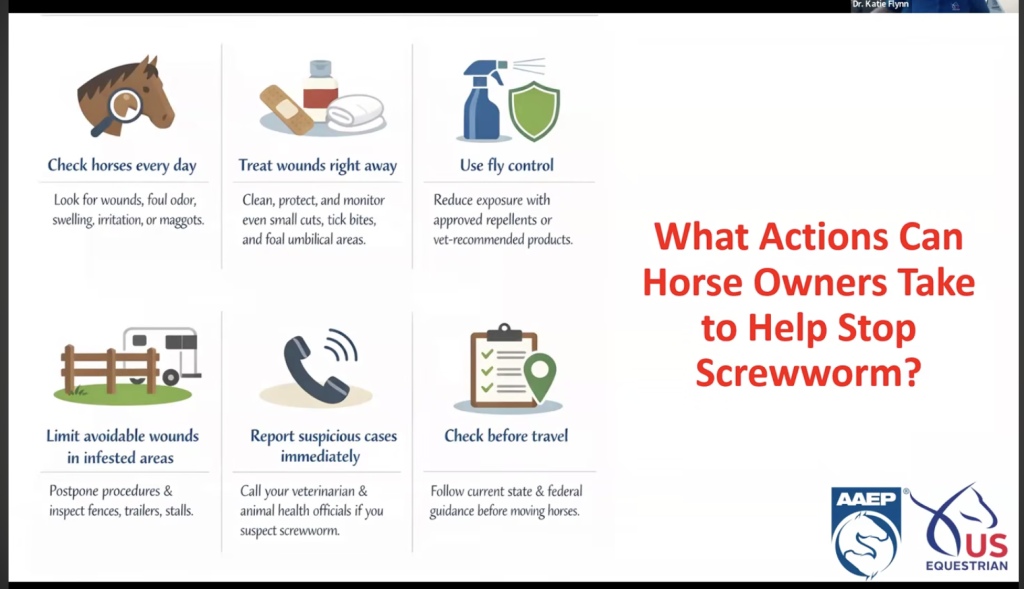
Flynn said horse owners can help stop the spread of NWS by keeping eyes on their animals.
“Just check your animals every day, inspect them for wounds, any foul odor, or if you start seeing those maggots, those need to be reported immediately to a veterinarian to determine what’s going on,” she said. “And then obviously, if there’s no maggots, but you see a wound that’s fresh, you want to make sure you clean that up and you treat it with a product that has efficacy against New World screwworm.”
A list of approved pesticide products is available on the screwworm.gov site.
“Fly control is always great. It’s more trying to prevent any wounds from those other types of flies,” she said. “That’s our purpose behind the fly control is to make sure we’re not creating those wounds, we’re also limiting wounds.”
Movement
Because of movement restrictions to and from NWS areas, it’s critical to check the status in an area before traveling. Flynn said all livestock exports are blocked from Mexico.
“The only thing that can cross right now are our dogs under protocol, but all other species are unable to cross the Mexico border into Mexico,” she said.
The only way horses can move across the border is horses can fly into the United States from Mexico. There is no horse movement from the United States into Mexico currently.
This is an evolving situation, and the USDA has a NWS response playbook to follow.
“Many states are still working on and finalizing state protocols specifically for movement of animals from an infested state or an infested area within a state to their state,” Flynn said. “So, it’s very important that you keep checking the state veterinarian’s websites for updated protocols, as these will continue to change throughout the incident.”
In areas where there is a confirmed case of NWS, a common question asked is how can horses be moved? Flynn said horse owners need to know and realize how much of a changing and evolving situation it is.
“You must always maintain communications with the state of origin, as well as the state of destination, because those requirements can change pretty rapidly, especially as new infested areas become confirmed,” Flynn said. “Or on the other side, as we start clearing areas, those infested areas may be released and no longer have any requirements.”
Moving horses from an infested zone does require an inspection by a certified inspector. In Texas, the Texas Animal Health Commission and the USDA do inspections.
“As this expands, there will be a certified inspection program that they have working on in Texas right now for additional folks that can do those inspections,” she said. “It’s important to understand that you need to have your event plans and your travel plans need to be flexible because they may be disrupted.”
Flynn said there may be rules and regulations put in place by states that won’t allow events, sales or shows in certain areas that have high infestations. Because of that it’s important to check with state of origin and state of destination and know what’s going on in those areas. If traveling internationally, there’s additional rules as well, she said.
“Just as a note, Canada also put restrictions on any horse that’s in Texas, the entire state of Texas and New Mexico—they are not allowed to travel to Canada,” she said “They have to be outside of an infested state for 21 days.”
Check before horses are shipped and know all the requirements for the state or country of destination are met.
“It’s a very unique situation that we normally only go with the requirements of the state of destination, but in the case of New World screwworm, especially when there’s a state that is an infested state, there are additional requirements that must be met before you leave the infested state,” she said.
Events
Flynn said movement of animals is likely the way NWS was introduced to a new area, and equine owners need to be careful about moving their horses for competitions, events or sales.
“Make sure if they do have a wound that that wound is examined before they move, and the topical treatments are placed on those wounds, so that we don’t get the larvae or the eggs laid for the larvae to develop,” she said.
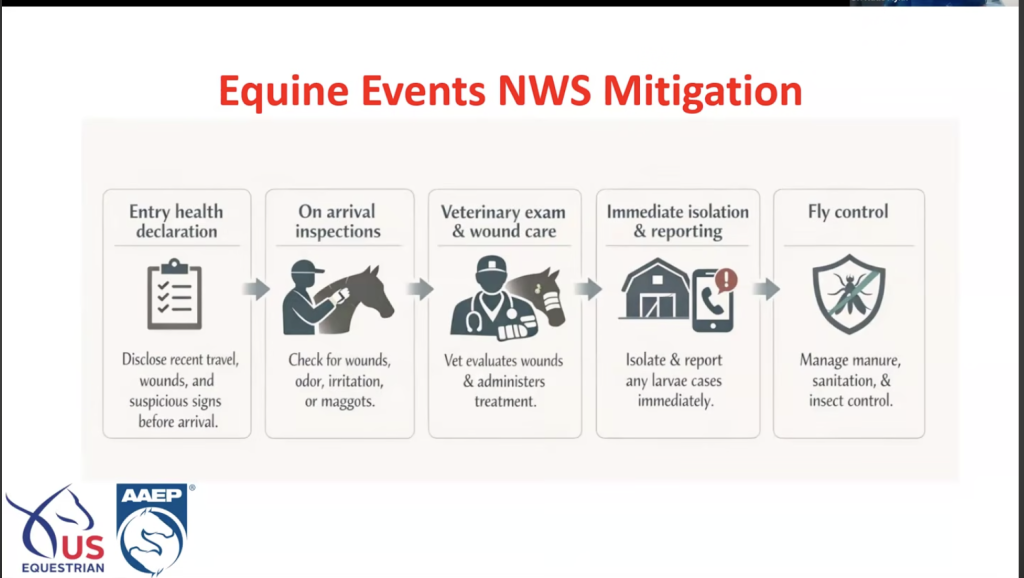
Health declarations are important upon arrival, so officials know where the animals came from and where they’ve traveled.
“We’re looking at making sure on arrival to inspect them for wounds, those odors, or irritations, or actual visual maggots in there if they do have wounds,” she said. “They should be treated and continued to be examined for seven days to make sure that the maggots aren’t hiding.
Since it takes five to seven days for the larvae to develop and drop to the ground, it’s important to watch for seven days to see if one was missed, as movement pushes spread.
“We don’t want those larvae to drop to the ground and pupate, because we don’t want the adult fly to establish in a new area,” she said. “So, those horses, if they do have a larva, and they were identified at their destination at an event, they should be immediately put into isolation, and that obviously should be reported to the state or our federal animal health official in that area and then implement control measures to prevent any issues on that grounds.”
As of June 18, USEF released to their competition managers protocols for NWS. Those include things like an on-site inspection of horses coming from an infested state.
“If they have a wound, they either have to have come in with documented treatment by the veterinarian, or they will be treated by the veterinarian at the competition and monitored for that seven-day period,” she said. “And obviously any larva that are identified, the veterinarian will immediately contact state and federal animal health officials.”
Flynn said there may be a time where states may say that if it’s an infested area, there will not be any equine events.
“You have to work with your state in advance of your event to determine what those protocols are going to be,” she said.
It will continue to be an evolving situation, with Texas and New Mexico in critical areas with active cases.
“Bottom line, it’s here, but don’t panic. You need to take action, though. You need to inspect your horses for wounds, report any larva, and protect your horse by covering any wounds with a product that’s going to be effective against New World screwworm,” Flynn said. “Again, the quicker the action, the quicker the control, and we’re going to stop New World screwworm.”
Kylene Scott can be reached at 620-227-1804 or [email protected].