Latest hogs and pig report shows slight increase in numbers
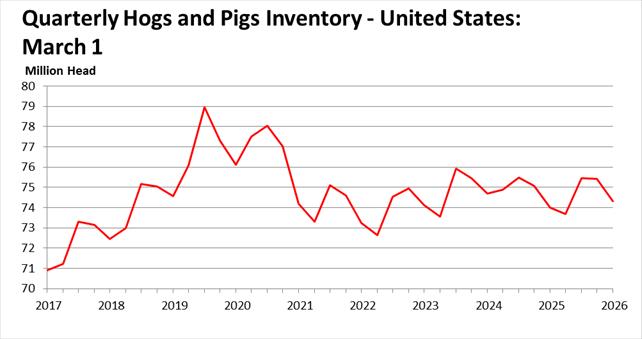
The latest Quarterly Hogs and Pigs report showed a slight increase in inventory when compared to the same time a year ago.
As of March 1, there were 74.3 million hogs and pigs on United States farms, according to the U.S. Department of Agriculture’s National Agricultural Statistics Service. The report was released March 26.
NASS said in the inventory, the numbers were up slightly from March 2025, but down 1% from Dec. 1, 2025.
Key findings
- Of the 74.3 million hogs and pigs, 68.4 million were market hogs, while 5.89 million were kept for breeding.
- Between December 2025 and February 2026, 33.2 million pigs were weaned on U.S. farms, up 1% from the same time one year earlier.
- From December 2025 through February 2026, U.S. hog and pig producers weaned an average of 11.9 pigs per litter.
- U.S. hog producers intend to have 2.86 million sows farrow between March and May 2026, and 2.9 million sows farrow between June and August 2026.
- Iowa hog producers accounted for the largest inventory among states, at 24.7 million head. Minnesota had the second largest inventory at 9.3 million head. North Carolina was third with 7.6 million head.
Analysts weigh in
Generally, an actual result that is more than 1% different from the average of analysts’ pre-report estimates is considered a surprise, said Holly Cook, an economist with the National Pork Producers Council.
In the March report, the total hogs and pigs and the market hog inventory number were less than 1% off the average estimate, but the U.S. breeding herd came in 1.3% below expectations and 1.5% smaller than March 2025, she said.
“The number of pigs saved per litter also exceeded expectations by 1.6% and set a new record for the quarter with 2.1% growth from the prior year,” Cook said.
Lee Schulz, chief economist for livestock with Ever.Ag, said numbers were in line with most categories. He spoke during a video call with producers for the National Pork Producers Council.
Minor revisions were made primarily affecting market hog inventories and the breeding herd. Changes included a 120,000-head increase in the Sept. 1 market hog inventory and a 49,000-sow reduction in the breeding herd.
“I think that is one interpretation of the market that we’re not seeing larger supplies now, but we’re also not seeing shrinking supplies. The other important takeaway is at least relative to pre-report expectations overall we would see tighter levels than what those pre-report expectations would tell us,” Schulz said. “How much and for how long our markets react to that, I think, is to be debated. And the other big takeaway was that I wanted to give USDA credit. That last hog and page report in December was spot on as we looked at the market hog inventories in aggregate.”
Hog slaughter from December to March matches reasonably well with the market hog inventories and pig crop information reported in the December report, Cook said.
Cook noted the difference in hog numbers year-over-year compared to the 1% decline from December.

“The majority of the U.S. hog inventory increase came from the 2.5% increase in the 180+ pound market hog inventory category,” Cook said. “While this result was 1.6% higher than analysts predicted, hog slaughter since March 1 has been up about 2.1% based on weekly data which is fairly consistent with this weight category. The other three market hog weight categories suggest that hog slaughter from Mid-April through August should be similar to 2025.”
Economics
Cash receipts for 2026 are forecasted at $29.3 billion. Schulz said because of the impact of inflation, those dollars won’t go as far. The cost of production remains elevated with a forecast increase of $4 per hundredweight for 2026. Annual average profitability for 2026 is projected at $15 per head, with a range from a $7 per head loss to a $40 per head profit.
Seasonally, the stronger demand normally kicks in during the summer, he said.
Schulz said in the U.S. Department of Agriculture’s World Agricultural Supply and Demand Estimates report released March 10, it projected a 2.5% increase in pork production in 2026 from 2025.
“Based on the March WASDE, USDA forecasts showed increased pork production and higher (or equal) hog prices in every quarter of 2026 when compared with the same quarter in 2025,” Cook said. “Higher hog prices during a time of increased production suggests stronger pork demand.
“USDA will adjust its next forecasts to incorporate the results of the latest Hogs and Pigs Report, including the lower-than-expected pig crop and updated farrowing intentions, which suggest that some quarterly production forecasts may be reduced.”
Total exports are up 2.8%, with muscle cuts up 2.2% and variety means up nearly 6%, although it has come at lower prices, Schulz said.
Turmoil as a result of the war with Iran that has driven up fuel costs and how it could impact consumer spending is yet to be determined, Schulz said. Pork has remained resilient, and consumers so far have continued to purchase beef and poultry, too. Consumers do consider the price of protein substitutes in their buying decisions.
“I think we’ve really seen some strong growth in consumer taste and preferences for pork, and we’ve really grown some momentum,” Schulz said. “All of those factors that impact demand can be moving all in the same direction or in opposite directions, or they can help offset each other.”
Cook said producers will need to continue to watch multiple factors. “While the current outlook suggests market opportunities for 2026, pork producers remain diligent in managing a variety of risk factors related to production costs, market prices, and animal health.”
Dave Bergmeier can be reached at 620-227-1822 or [email protected].