
Lahoma Field Day highlights wheat variety testing and disease management
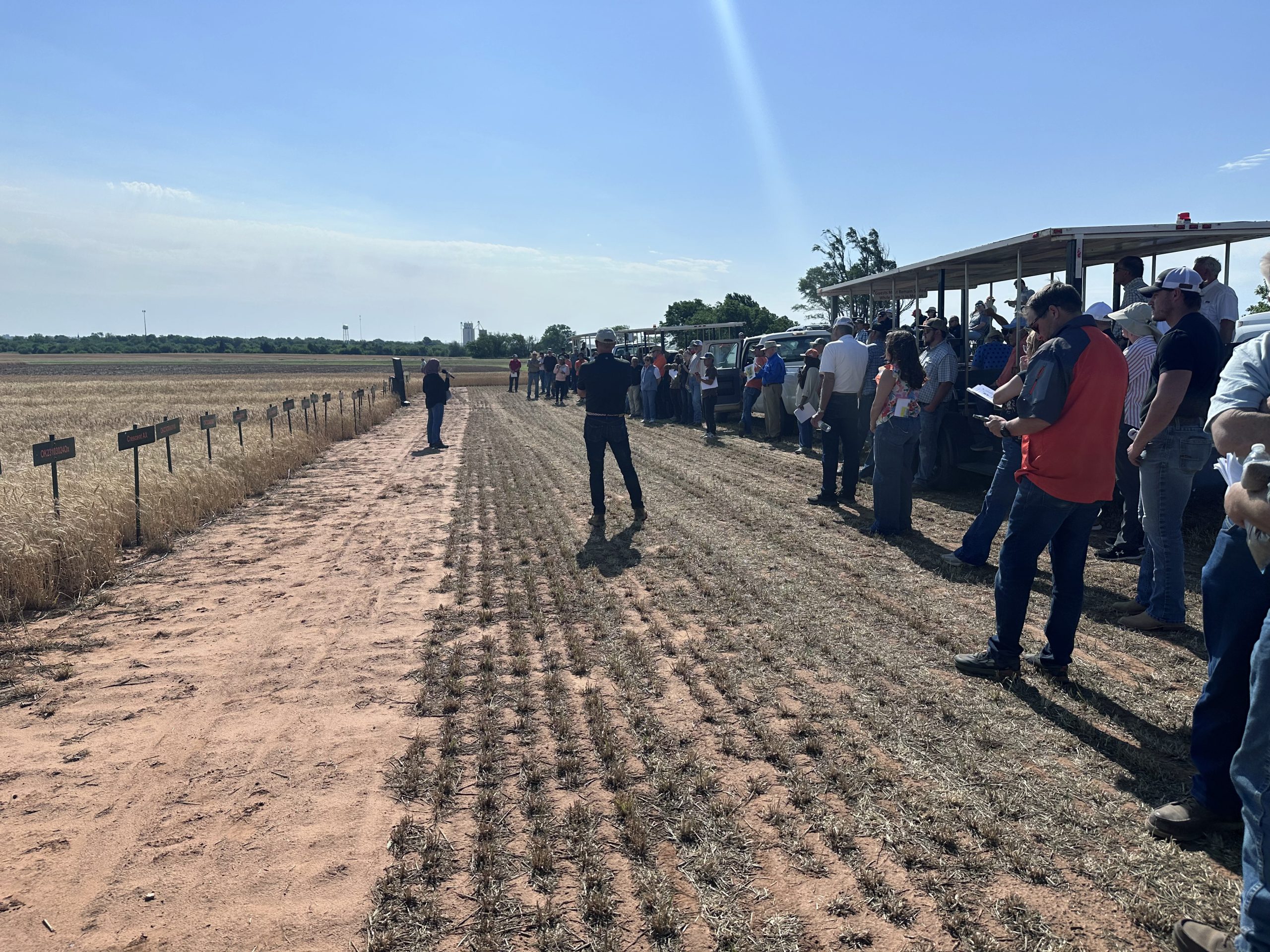
Wheat streak mosaic virus, variety selection and forage management were key topics discussed during the May 15 Lahoma Wheat Field Day, at the Oklahoma State University North Central Research Station near Lahoma, Oklahoma.
Dry conditions have plagued the state, and the lack of moisture has pushed the current wheat crop to ripen early. Some producers could not attend the field day due to the start of harvest.
OSU specialists, including Amanda De Oliveira Silva, Meriem Aoun and Brett Carver led producers through research plots and shared updates on wheat variety testing, disease management and breeding strategies aimed at improving wheat performance under Oklahoma conditions.
Standard versus intensive management
Silva, OSU small grains Extension specialist, showed attendees replicated wheat plots at the research station comparing standard and intensive management systems across 52 wheat varieties from multiple companies and breeding programs.
The intensive management plots received two fungicide applications and an additional 40 pounds of nitrogen, allowing researchers to compare how varieties respond under higher-input systems and disease pressure.
“This is a very good opportunity here for us to see how these varieties are holding up on diseases,” Silva said, referring to heavy pressure from wheat streak mosaic virus and leaf rust this season at the Lahoma station.
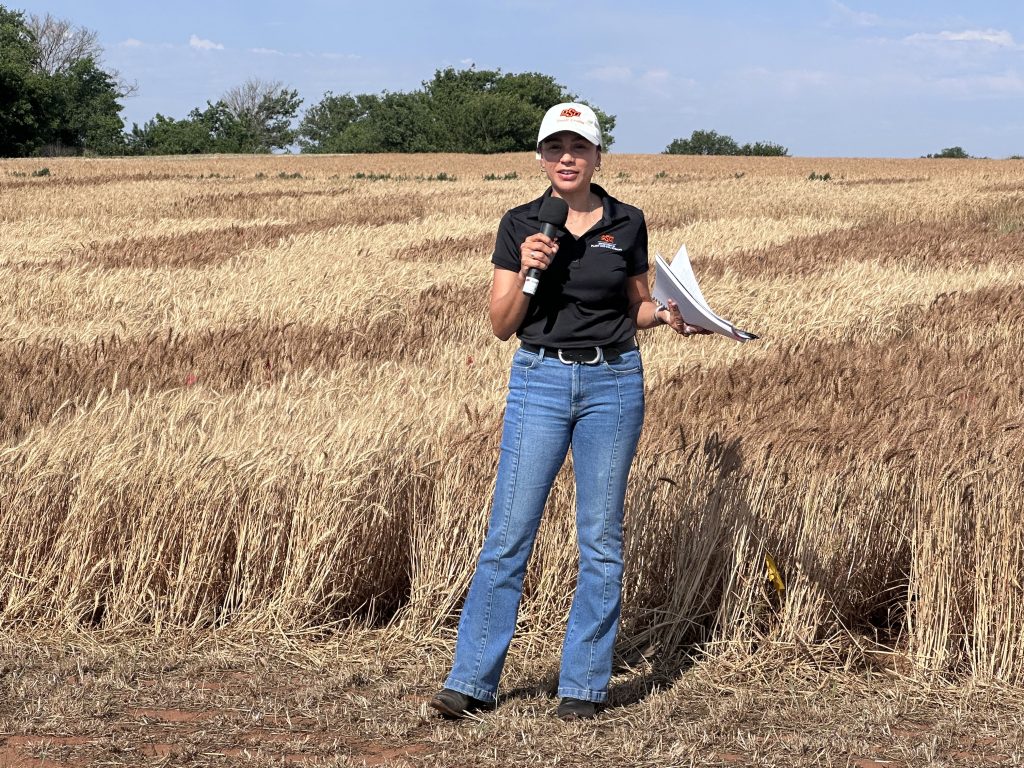
The trials were planted Oct. 16. Standard management plots were seeded at 60 pounds per acre, while intensive management plots were planted at 1.2 million seeds per acre.
Silva said the OSU variety testing program now evaluates much more than grain yield. Researchers also collect data on forage production, disease resistance, acid soil tolerance, germination under hot and cold soils, maturity, shattering, and first hollow stem development.
Lahoma’s 2024 standard management trial averaged 66 bushels per acre, while intensive management averaged 87 bushels per acre.
Among the top-yielding varieties in the standard management trial were AP Sunbird, AP24 AX, Crescent AX, KS Bill Snyder, KS Territory, LCS Steel AX and Orange Blossom CL+. Under intensive management, AP Sunbird yielded 104 bushels per acre and ranked among the top entries alongside AP Bigfoot, AP24 AX, Crescent AX and KS Bill Snyder.
Silva emphasized the importance of evaluating multiple years of data when selecting varieties.
“We all like to see how the trials did last year, but for variety selection, we all know how important it is to look at two-, three-year data,” she said.
Dual system, disease research
The OSU program also evaluates varieties used in dual-purpose systems for both grazing and grain production. Researchers measure forage accumulation and monitor first hollow stem development, which determines when cattle should be removed from wheat pasture to avoid grain yield losses.
The data show major differences among varieties in forage production and grazing duration. Some varieties produce heavy fall forage, but reached first hollow stem earlier, shortening spring grazing opportunities.
Varieties such as AP Road Runner, AP 24 AX and Gallagher reached first hollow stem earlier, while Double Stop CL Plus, KS Mako and Sheridan were among the later-developing entries.
Silva also reviewed disease resistance data collected during recent rust outbreaks. Varieties including Breadbox, OK Corral, Orange Blossom CL+ and Paradox showed strong resistance to stripe rust and leaf rust.
Breakthrough remained one of the strongest varieties against WSMV because it carries the WSM1 resistance gene. Still, Silva stressed that cultural management remains essential.
“When you go ahead and you spray, you want to leave at least two weeks after you spray those volunteer weeds to make sure it’s brown dead before you come and you plant your wheat,” she said.
Researchers also continue studying acid soil tolerance and emergence characteristics. Silva said low pH soils can reduce root growth and forage production in susceptible varieties.
Wheat streak mosaic virus remains a concern
Aoun, OSU small grains pathologist, focused much of her presentation on wheat streak mosaic virus, which she described as the most widespread and damaging disease observed across Oklahoma this season. The disease complex includes WSMV and triticum mosaic virus, both spread by the wheat curl mite.
“Although the infection can happen in spring, the fall infection is the most damaging to yield,” Aoun said.
She said the OSU Plant Disease and Insect Diagnostic Laboratory received a higher number of positive samples for both WSMV and TMV this year compared with previous seasons.
Volunteer wheat and grassy weeds remain major sources of infection because they allow wheat curl mites carrying the viruses to survive between crops.
“We need to make sure that volunteer wheat and grassy weeds are completely dead at least 15 days prior to planting,” Aoun said.
Delayed planting can also reduce infection pressure by lowering exposure to wheat curl mites during the fall. Aoun said early planted wheat often showed more severe damage than later planted fields in OSU research trials.
Aoun agreed with Silva, that the Breakthrough variety continues to provide some of the strongest resistance to WSM because it carries the WSM1 gene.
“For now, this is the most effective,” Aoun said. “So, if a variety is carrying WSM1, it should give that good protection, even if we have high disease pressure. The second gene is WSM2. This is a gene that can provide resistance to the WSMV, but not to the triticum mosaic virus.”
Aoun said TMV was more common in Oklahoma this year. Some varieties that carry the WSM2 gene include KS Bill Snyder, KS Territory, and KS Mako.
She also discussed barley yellow dwarf virus, another disease transmitted by aphids. Aoun said delayed planting, volunteer wheat control and resistant varieties remain important management tools for this disease.
She said leaf rust also became widespread this season despite dry conditions. Fungicides and resistant varieties remain the primary management tools for rust diseases, though Aoun warned that rust pathogens evolve rapidly and can overcome resistance genes.
Disease resistance in variety development
Carver, OSU wheat breeder, reinforced concerns about the long-term threat posed by WSMV and the increasing importance of genetic resistance.
“This is not just a temporary problem,” Carver said. “I think we’re going to have to be dealing with this for the long term.”
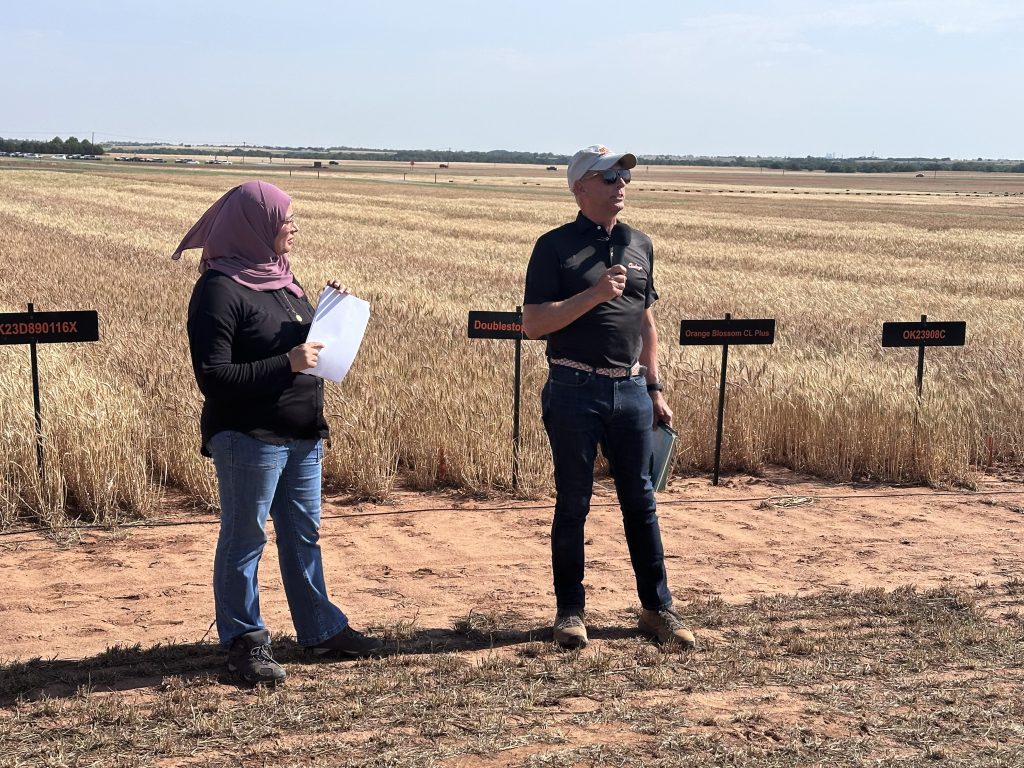
He described one OSU trial in which wheat planted earlier escaped severe damage while later-planted wheat in the same area suffered major yield losses.
“We’re talking about a 30- to 40-bushel difference last year,” Carver said.
The breeding program is working to combine multiple resistance genes into adapted Oklahoma wheat varieties while maintaining strong agronomic performance and grain quality. Carver said breeders are also combining WSM2 and CMC4 mite resistance genes into experimental lines to improve protection against the wheat streak mosaic complex.
One experimental line combining WSM1 and CMC4 resistance has performed well under heavy disease pressure in testing environments. Carver also discussed newer resistance sources, including WSM3, which is still under development and has not yet been widely incorporated into commercial varieties.
“We want to get just the WSM3 gene,” he said, referring to efforts to eliminate undesirable traits linked to the resistance source.
Updates for the OSU wheat breeding program
Beyond disease resistance, Carver reviewed ongoing work with CoAXium wheat lines, forage-focused varieties and specialty wheat classes. The breeding program has spent several years developing CoAXium lines with improved grazing ability, grain quality and herbicide tolerance.
“We don’t have to release a CoAXium variety right now,” Carver said. “But do we want to be in that game? I think we do.”
Several experimental CoAXium lines remain under evaluation after extensive crossing and testing that began in 2018 and 2019. Carver also highlighted work involving strong dough wheat such as Paradox, which was developed for specialized flour functionality and baking applications.
“We’re also looking for the next rendition of Paradox,” he said.
Another breeding focus involves forage and silage wheat development. Carver discussed efforts to develop improved beardless wheat with strong biomass production and grain potential. One experimental beardless line, however, proved highly susceptible to WSMV under field conditions.
“That’s the luck of the draw of plant breeding,” Carver added.
Carver said breeding decisions increasingly involve balancing disease resistance, yield potential, grazing ability, herbicide tolerance, maturity, and end-use quality.
Experimental lines now undergo extensive evaluation under varying environmental conditions and disease pressures before release decisions are made. Even with ongoing disease challenges and difficult weather conditions, Carver said the breeding program continues pushing toward improved wheat varieties adapted for Oklahoma producers.
Lacey Vilhauer can be reached at 620-227-1871 or [email protected].



