Southern Plains drought webinar discusses weather, agriculture
Agriculture reaps the riches when Mother Nature provides. But in the last dozen years, that’s not always been the case. Despite moisture in much of 2025 for the Southern Plains region, the drought in Texas, Oklahoma and Kansas has worsened over the winter.
Jourdan Bell, with Texas A&M AgriLife Extension, shared her thoughts about drought and decisions farmers and ranchers are facing during a recent National Integrated Drought Information System Southern Plains webinar.
“We know weather decisions impact agricultural producers’ daily lives and so every producer who I work with, whether it is in row crop production or livestock production, follows closely daily weather patterns and then does make decisions based off of these long-term forecasts,” she said. “I would say that every farmer in the Southern Plains still considers the current drought to be extremely problematic.”
Bell said with the current drought, the wheat crop is probably suffering the most, as many are reporting record failure rates, in addition to extreme water stress on the rangelands.
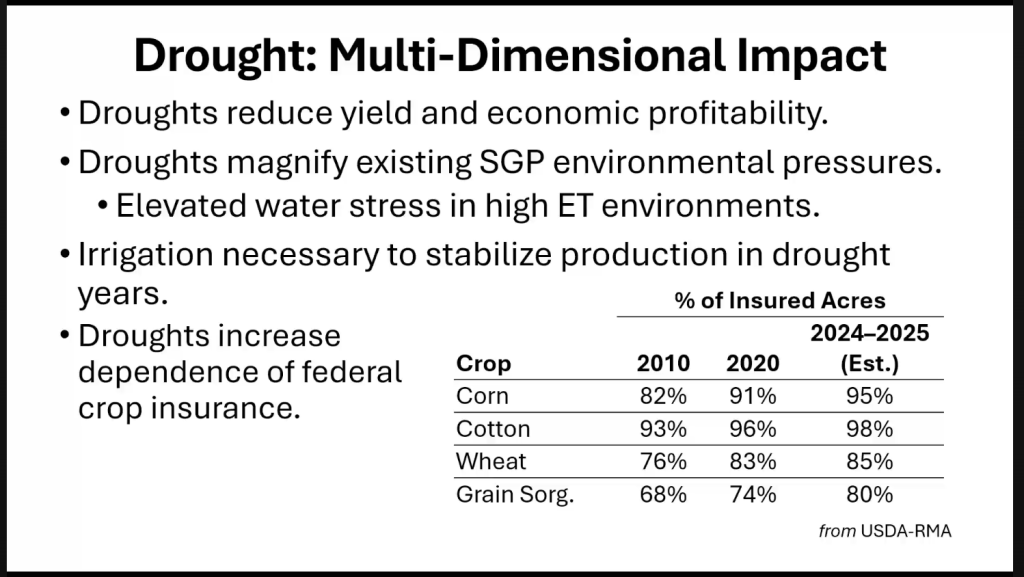
“As producers are making their cropping decisions moving into this summer, this is significantly impacting how they make these cropping decisions,” she said. “It’s definitely a multi-dimensional impact.”
Yes, there’s drought and that’s going to reduce yield and economic probability, but there is so much more to it. Droughts magnify challenges in the Southern Plains region as environmental pressures tend to be severe. Plus, water stress adds to the problem.
“We know that the droughts are increasing farmers’ dependence on federal crop insurance,” she said. “We do see an increase in the percent of our insured acres, the percent of farms that are depending on insurance to mitigate risk. And what is challenging is that it’s not just the farmers who are using crop production to mitigate risk.”
Bell said many farmers struggle with getting production loans from a bank unless they have crop insurance, and those premiums aren’t getting anything but more expensive.
Retaining limited moisture
Those in agriculture want to protect the soil surface and keep evaporation to a minimum, in the southern Great Plains, she said, where some of the highest rates of evapotranspiration occur.
“In the southern Great Plains, we have a class A evaporation rate of approximately 95 inches per year in and that is almost half of what we see in Nebraska, which that does explain why they can successfully grow dry land corn in most years in Nebraska,” she said. “That becomes a very risky practice in the southern Great Plains.”
Irrigation’s limits
When talking about evapotranspiration in the region, it’s restricted by not just the wind and low relative humidity levels, but also rainfall. Going west, precipitation is going to be less than the environmental demand, and the deficit has to be made up somehow. That’s where irrigation plays a role.
“However, the declining Ogallala Aquifer and ultimately reduced irrigation capacities have limited producers’ ability to mitigate production risk with irrigation,” she said.
Even though irrigation in the region has a short history—rapid adoption of irrigation didn’t happen until after World War II. The widespread adoption of the centrifugal pump led producers to expand crop production and the profitability of crop production across the Southern Great Plains during the second half of the 20th century, she said.
“But as we now move forward, we see that the declining Ogallala Aquifer, especially in the Texas High Plains, has become extremely restrictive,” Bell said. “Producers are having to concentrate their irrigation capacity on reduced acreage in order to maintain those water use efficiencies.”
In the Southern Plains region, many who irrigate often choose between corn and sorghum, depending upon their water availability. Corn’s peak water use is about 35 hundredths of an inch of water per day. It also requires more than 25 hundredths of an inch for more than two months.
“Based off of those figures, we need higher irrigation capacities to meet that crop water demand,” she said. “And because we have cyclical weather events, we do not often have timely rainfall during these peak water demand periods, irrigation is necessary to stabilize the yield losses during those critical stages.”
Conversely, sorghum is a drought and heat tolerant crop that does have a low water demand, so those producers who have lower irrigation capacities can get by with it.
Irrigation is necessary to stabilize production, especially in droughts. Since the 2011-13 droughts, irrigation capacities have declined during the last 15 years; producers just don’t have the capacity to make up for water losses.
“The economic disasters that producers are facing today are greater than the economic losses and the hardships that were faced during the drought of ‘11 and ‘12 and ‘13, because they do not have the irrigation capacity to make up for that demand,” she said.
When you think about those factors and the systems in agriculture, soils are essential for successful crop production—but drought does destroy soils.
Residue is a key factor of the soils, Bell said. If there’s no rainfall or irrigation to establish the crop, there’s no residue to hold soil in place, making them more susceptible to erosion.
“Another challenge that we see, beyond just the erosion potential, is that some soils become hydrophobic during drought conditions,” she said. “Soils become baked under hot, dry conditions, and the organic matter at the surface becomes waxy, and that waxy layer then repels the water, and hydrophobic soils are not receptive to small, ineffective rainfall events.”
During drought periods, there may be small, infrequent rainfall events that could reach a “couple hundredths of an inch,” she said. But they won’t be of any benefit because of the stressed soil conditions.
Biological activity and the health of the soil is important to recognize when there are dry conditions and decreased soil moisture.
“The decreased soil moisture results in decreased mineralization of the crop residues, but ultimately this goes back to also decreased soil microbial activity,” she said. “The soil microbes are living organisms, and they require soil moisture to be active, decreased soil microbial activity results in decreased soil enzyme activity and ultimately reduced soil nutrient cycling.”
Soil microbes will either die or even become dormant during stressful environmental conditions, she said. Soil fungi or bacteria will also become unbalanced.
Bell said crops will also use less soil nutrients during a drought, and that’s because nutrients are taken up by mass flow—roots take them up with soil water.
“If we do not have the soil water solution, we see reduced soil nutrients taken up,” she said. “We will also see nitrates potentially accumulate. So that is going to be the nitrate fraction of the nitrogen that accumulates in the soil and that can potentially result in toxic nitrate levels in forages.”
Weed pressure
Weeds also become a problem when it’s dry. Water stressed weeds become hardened and are not receptive to herbicide applications.
“It becomes harder for producers to control those weeds,” she said. “But also, there are residual herbicides that are soil applied, and once there is enough moisture, the herbicide becomes active, the weeds will take up that herbicide in soil water solution, and then it’ll ultimately kill the weed. But if we have dry soil conditions that residual herbicide does not become activated, and it can even accumulate in soils under drought conditions.”
Soil acidity can increase during dry conditions, too, thus fertilizer salts are not leached by rainfall, resulting in a higher hydrogen ion concentration and lower soil pH at the soil surface, she said.
As a reminder, Bell said to remember when managing soils under drought conditions, first to think about how to maintain residues.
“What has become extremely challenging for producers—is that if producers are unable to control weeds, they will often revert to plowing,” she said. “Now another challenge that producers have because of the cost of production today is that many have decided it’s cheaper to plow rather than to spray weeds, but hardened weeds that are not controlled by herbicides, producers will plow and that results in bare soil surfaces and so we wind up with this very cyclical problem and soils that are susceptible to erosion.”
Surface residues on both cultivated and grazed lands need to be maintained, and so many annual forages are grazed, and if there is intensive grazing, or even forages that are harvested, it becomes even more critical.
Bell said it’s better to have an average year with rainfall that is distributed appropriately than these extreme periods of heat that can flank either part of the season.
When looking toward future management and since droughts are cyclical, producers know they’re going to return.
“Texas ranchers and farmers are facing more severe droughts, longer duration, higher temperatures, less rainfall,” she said. “And of course, this extends just beyond the Texas High Plains, Oklahoma Panhandle, western Oklahoma, eastern New Mexico, southwest Kansas, this whole southern Great Plains region faces the same challenges.”
It’s important farmers and ranchers understand how crops and soils respond to drought and what weather projections mean.
Kylene Scott can be reached at 620-227-1804 or [email protected].