
Farming for data—land, energy, output
What is a data center? It is not a grain bin with better Wi-Fi, and it is not a factory that hires the county. It is a plant that turns land, steel, and a continuous diet of electricity, and often water, into computing.
The bill of materials is familiar to anyone who has watched a feed mill go up: a pad, a building, heavy concrete, busbars and transformers, chillers or cooling towers, fiber in the ditch, and a locked room or hall full of racks. The unfamiliar parts are the chips and the load. A conventional hyperscale hall of about 100 megawatts draws as much power as a city of 100,000 homes.
Site selectors now look for 250 megawatts and 125 acres or more. Building the shell runs on the order of $12 million to $18 million per megawatt before anyone racks a GPU. What it does not run is a payroll. Once the cranes leave, an automated 100-megawatt hall may operate with two or three dozen people. Construction is a harvest. Operations are a night watch.
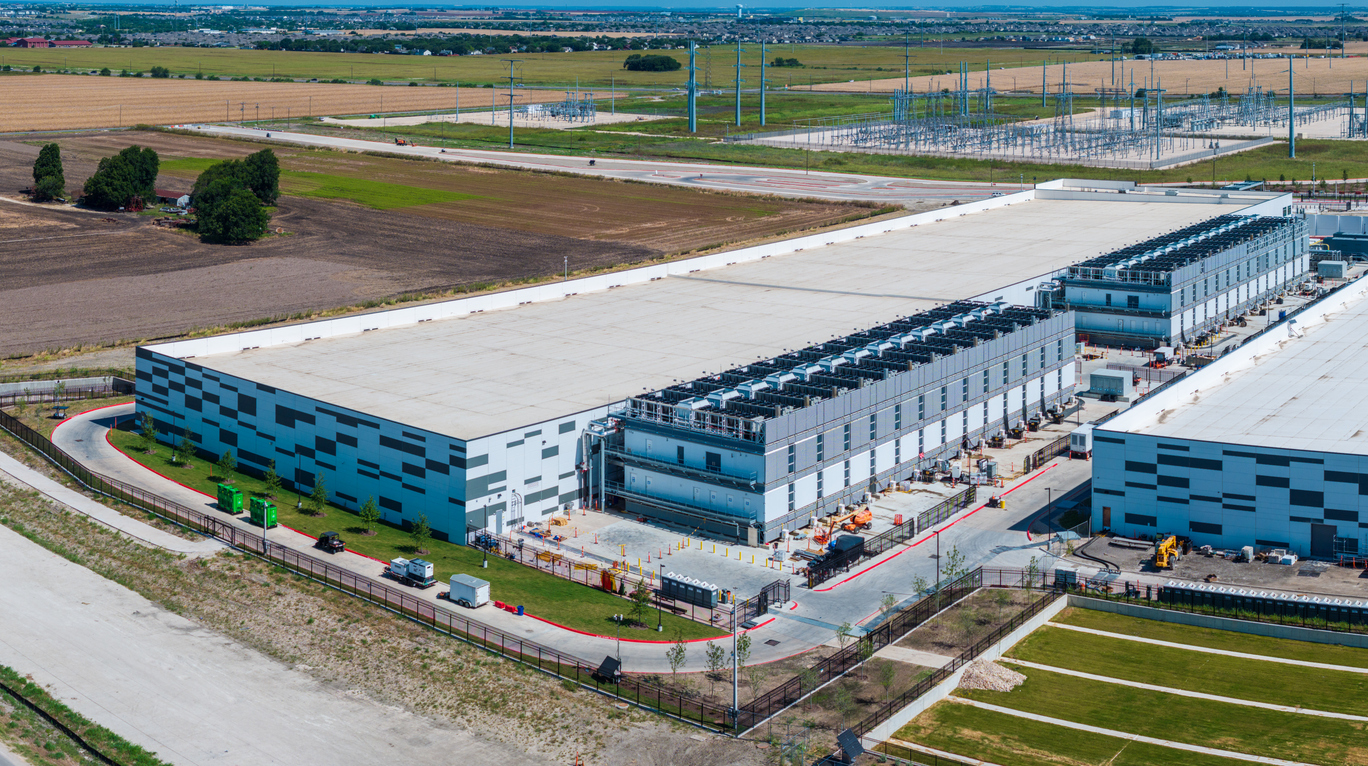
Pictured at top is an aerial view of a large data center campus with focus on the processor hosting area and power and cooling infrastructure being built in Hutto, Texas. (iStock-#2284670826 │ BackyardProduction)
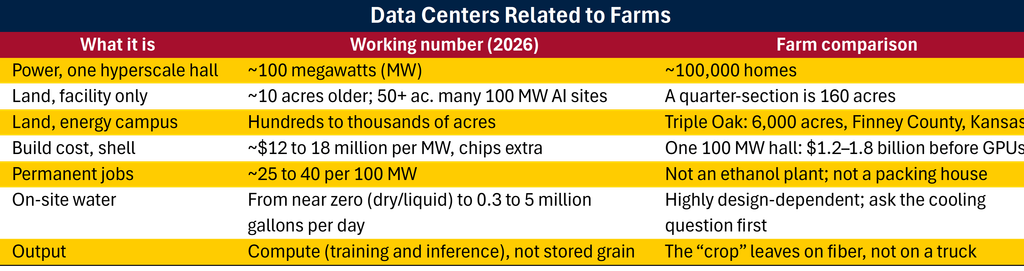
That is why the option letter on a High Plains table is not a real-estate flyer. It is a claim on the same three things a farm already uses: land, energy, and, in many designs, the same water that grows the crop.
At the horizon: where the data centers are, and where the steel is going
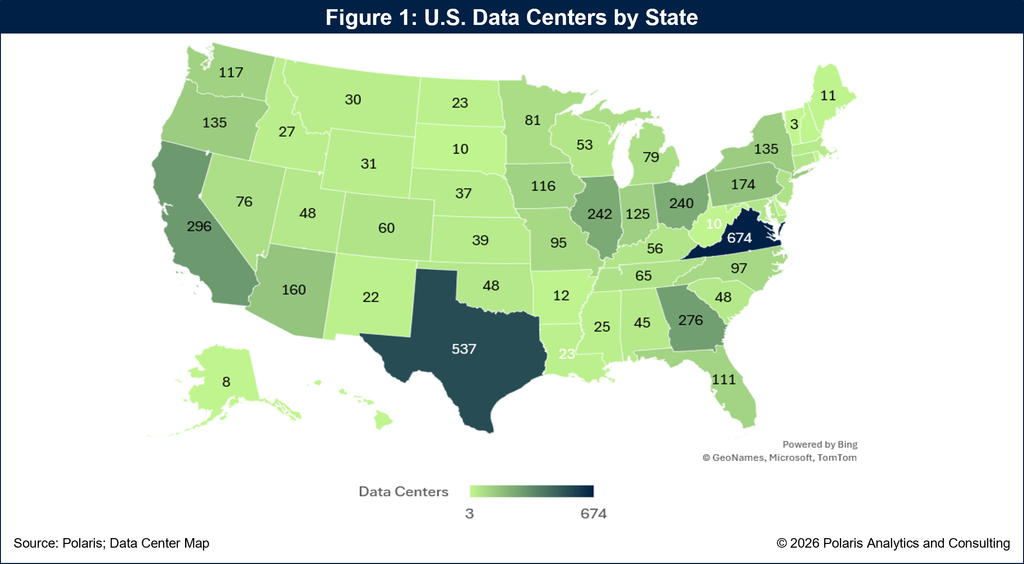
Directories that inventory data centers, not megawatts, now list about 4,800 data centers in the United States, up roughly a tenth since May. Virginia still has the most buildings (674 in Figure 1). Texas is second at 537, about one in nine U.S. facilities, and it is the heavyweight inside any High Plains total.
Count Texas with Arkansas, Colorado, Iowa, Kansas, Missouri, Montana, Nebraska, New Mexico, Oklahoma, South Dakota, and Wyoming, about 1,000 facilities in the High Plains, roughly one in five in the country. That is a headcount, not a power ranking. A small, rented building next to the interstate and a gigawatt campus on irrigated ground both count as one building on that map.
Chad Barrett, who runs market intelligence at Data Center Map, the source behind Figure 1, now counts 12,259 facilities in 179 countries. The United States has about two in five of them, on the order of eight times the United Kingdom. China shows up with a few hundred buildings, a few percent of the global count. Capacity is a different map. Northern Virginia still dominates operating hyperscale load. New steel is moving inland toward land and electrons.
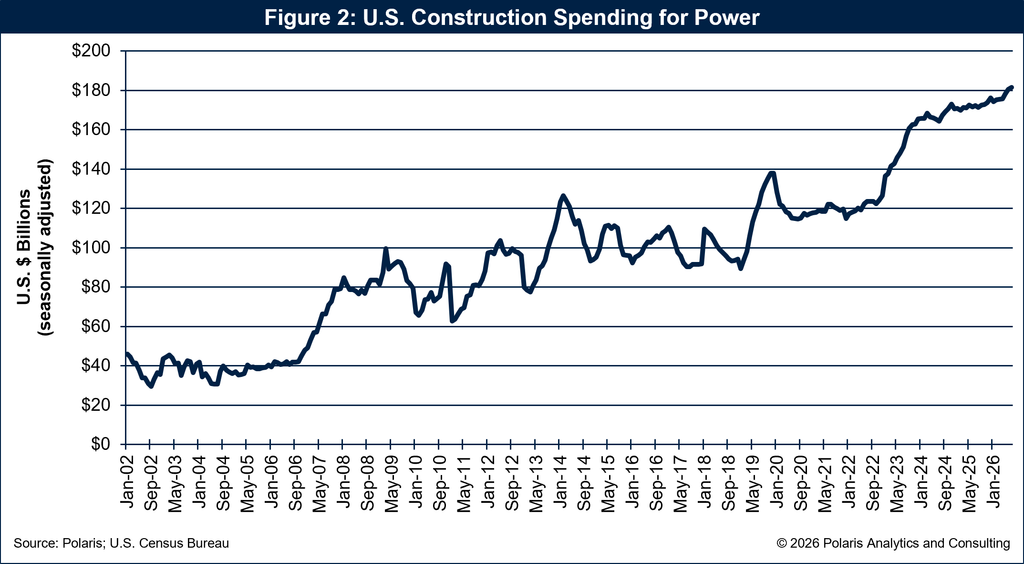
Construction books explain the energy half of the story. Census power construction—generation, transmission, and related work—is running about $182 billion at a seasonally adjusted annual rate in Figure 2, up some $60 billion since late 2022 and at a 20-year high on this series. That line is not a data-center tally. Data-center buildings sit in the office category, about $75 billion at an annual rate in July, up more than half from a year earlier. Read them together: the centers need land and load; the load needs steel in the power account.
The surge in energy construction is, in no small part, steel erected so computing can run.
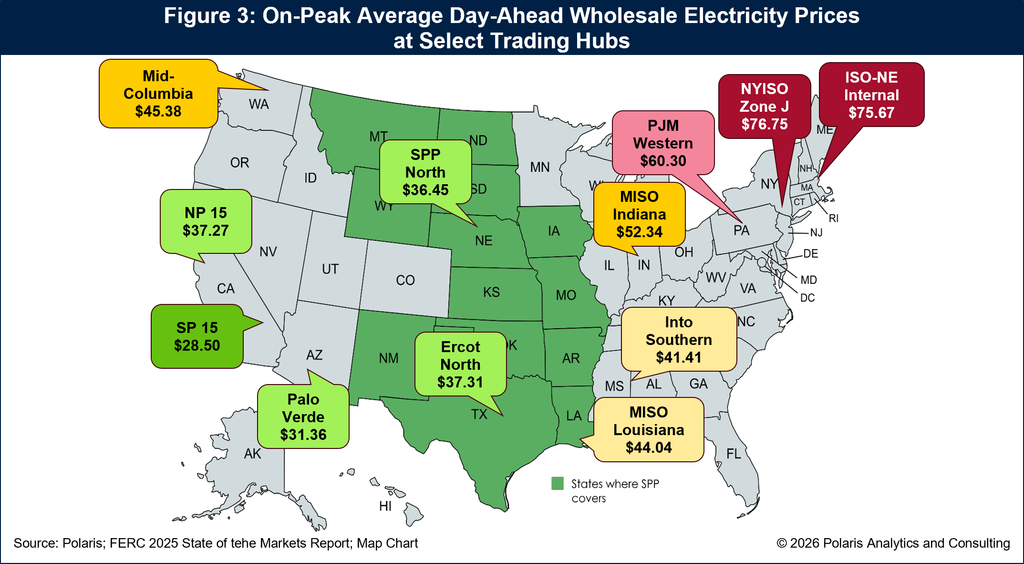
Follow the electrons. Open space, water, and a seat in the Southwest Power Pool are why offer letters hit High Plains kitchen tables. In 2024, SPP North was the cheapest organized hub on FERC’s file, at $27.87 per megawatt-hour. In 2025 FERC posted $36.45, up 31%. New York Zone J and ISO-NE cleared near $76 in Figure 3. Cheap relative to the coasts is still the draw. Cheap as last year is not the story.
On the horizon: an industrial site, not a farmland sale
Call them what they are. A hyperscale campus is an industrial site that happens to want cheap land, open sky, water, and electrons. The ones shopping irrigated quarters are measured in hundreds of megawatts. Two questions decide the plat: who is on the letter—an operator, a developer, or a speculator flipping paper—and how much load they intend to park. The “what” sets acreage, the substation, and whether the neighbor ever sees a line.
Roger McEowen, Kansas Farm Bureau professor of Agricultural Law and Taxation at Washburn University School of Law, has been walking producers through that letter. In a June 29 paper for K-State’s AgManager, he drew a hard line, “these transactions are not ordinary farmland sales.”
They bundle “option agreements and zoning to water rights, environmental compliance and eminent domain,” he said. His advice is to retain an attorney after the letter is read or before the second conversation.
Developers typically start with an option, time to kick the title, the interconnect, the water, and the county, written to keep their flexibility and yours constrained. McEowen’s list is short enough to tape to your refrigerator, a definite expiration date; an escalating, non-refundable option payment; meaningful limits on assignment, so the name on the letter is not free to flip the paper to a stranger; and an express right to keep farming, planting, harvest, grazing, tile, conservation, U.S. Department of Agriculture programs, until the day it actually closes.
West of Missouri, water is still the call he gets most.
“Whether irrigation rights may be converted to industrial use depends largely upon state law,” McEowen said.
Changing the purpose, place, or point of diversion is an administrative filing that has to be made at the Division of Water Resources. Neighbors can protest at DWR and at the Groundwater Management District if a senior right is impaired. A Local Enhanced Management Area already on a pumping diet makes that filing harder. Cooling design is not a footnote. Air-cooled and liquid systems are important questions. Evaporative towers drink. Ask which one is on the drawing before anyone talks price.
Then look at the county map. Kansas leaves siting to cities and counties. Kansas Corn’s August listening-tour briefing in Sublette and Scott City put the fork in plain language, a county without zoning has limited public-safety oversight and deals by contract, development, roads are handled differently than a county with zoning process that writes rules, gives notices to adjacent owners, holds hearings, and can enforce by law.
The University of Kansas Energy Transition Atlas is the public place to see how uneven that patchwork is. Sedgwick, McPherson and Kingman are among Kansas counties that have used a pause to buy time.
Wind and solar pads are generally contract deals. The transmission line is not. The Kansas Corporation Commission sites lines over 5 miles and 230 kV or more. Landowners within 660 feet of the easement centerline get notice. The KCC defines reasonableness and necessity. The utility has eminent domain (K.S.A. 66-1,177). Attorneys say, “If you are notified, go to the meeting. Talk to neighbors. Hire counsel.”
Kansas Senate Bill 98 (approved in 2025) provides for a 20-year sales-and-use tax exemption if a qualified firm puts up $250 million, creates 20 Kansas jobs, signs a 10-year power purchase, and files a water plan. Commerce and the Fusion Center sit in front of the certificate. Electricity itself is not exempt. That courts the campus. It does not write your option or the co-op tariff. The Wall Street Journal reported in September that more than 10 states have paused or canceled data-center tax breaks after exemptions ran far past what lawmakers first scored, Ohio’s sales-tax exemption alone topped $1.5 billion last year. Lost revenue does not rebuild a rural rate base.
The building is only half the plat. Transmission, fiber, and access easements are where a neighbor who never got an option still loses a pass or a terrace. Large checks create tax and succession work a handshake will not fix.
Installment treatment, basis, recapture, entity cleanup, and the will that still says, “the home quarter.” McEowen’s rule is the same as a good sale of the ranch, assemble the tax, engineering, and valuation bench before anyone signs.
Who pays for the wire
Investor-owned utilities have started saying large loads pay for their own interconnection. Member-owned cooperatives have to say the same, or the cost lands on a thin headcount, the irrigator, the elevator, the town. The hidden bill is not only the campus meter. It is the line, the pipeline, and, over the horizon, generation parked beside the pad. The last question is duration: who pays in year two, and who is still paying in year 20?
Farmers already sit on co-op boards. If the board packet is silent on incoming load, attorneys say members can read the minutes to learn more. Lee Tafanelli at Kansas Electric Cooperatives, the statewide distribution and generation and transmission co-ops, is the public voice on that allocation. Evergy is the investor-owned comparison. Follow the tariff, not the ribbon cutting.
Over the horizon: the letter you do not get
Most High Plains operators will not sell the pad. They will live next to someone who does, or next to an option that never pours. Assume abandonment, assignment, and a stranded easement are live cases. Right-to-farm statutes protect agriculture from nuisance suits. They do not stop industrial rezoning.
Barrett keeps three foreign pauses on the wall, Singapore in 2019, Amsterdam in 2020, Dublin in 2021. Dublin’s was closest to a physics problem, the grid, they thought, could not feed another campus. Singapore and Amsterdam paused to study. Load did not vanish. It moved. London, Frankfurt, and Spain picked up what those cities set down. “A moratorium does not delete demand,” Barrett said. “It relocates it.”
That is the rural risk in reverse. A county that slams the door before it has asked who is on the letter, how many megawatts, who pays the line, and what happens to the water can watch the campus, and the tax base, the construction harvest, and the opportunity to write the rules, go to the next county that stayed at the table.
Engagement is not a yes. It is refusing to decide blind. Transparency first; harness what serves the community, the local market, and the family that still wants a farm on the other side of the fence.
When the letter arrives, the useful gap is a one-page checklist and a lawyer who does water and ag real estate. Checkoffs can fund that education. They generally cannot lobby the incentive bill.
At the horizon, buildings can be counted. On the horizon sit the option and the tariff. Over the horizon, assume the campus while the line and the water filing show up on someone else’s plat first. Write the farm and the estate as if they already had.
Treat compute like any other new neighbor that drinks power and water. Know what it is, know what it is not, and do not sign the first paper that looks like a sale.
Ken Eriksen can be reached at [email protected].



